Showing posts with label Politics. Show all posts

Friday, 30 December 2011

Information: quality vs. quantity

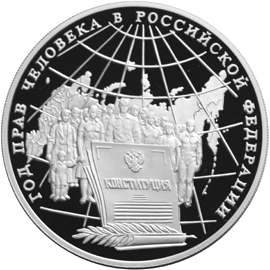
"A year of Human Rights in Russian Federation"


In 2011 the world bore witness to a myriad of life-shaping events. These ranged from the positive, to the bittersweet, to the downright treacherous. The sheer scope and variety of sociopolitical events worldwide resembled a bubbling soup full of all manner of ingredients; delightful to receive, difficult to digest. And when it was thought that nothing else of any significance was to happen in the eleventh hour, another moment confirmed its place among the most important of 2011. 
Russia released its very first report on human rights, which in part subverted United States foreign policy and challenged their presence on the international arena. It is very well known that China responds like-for-like to criticism by the USA through highlighting the US Government’s transgressions in the same areas. It seems Russia decided to follow the American exemplar and become the judge, jury and executioner. The timing of such a document’s release could not be better. The Russian government, through this document, implicitly claims to be the champion of democracy that exercises human rights in daily life. 
A protest in Moscow 2011
Recent demonstrations in Moscow and many other cities were pointed at gross manipulation of the 2011 general election results. Moreover, public indignation had fallen on Prime Minister Vladimir Putin as well as President Dmitry Medvedev. The two politicians are to swap places after the 2012 presidential elections. These events show the necessity of a change in tactics if the infamous ruling “tandem” are to retain power for the next 12 years - it is widely speculated that Putin will attempt to keep his presidential post for at least two 6-year terms. Russia wants neither political instability nor a ‘Russian Spring’, lest the December Revolution be repeated all over again. The protests were not, as widely reported in world media, a sign of people ‘no longer being afraid’ and illustrating such by demanding from its government a re-election. Rather, these events indicate the government’s efforts to depressurize the steam that is public frisson - such disorder was indebted to the sudden prevalence of information - in order to placate the masses and maintain the status quo.
As it becomes more and more difficult to control the flow of information, governments, politicians, corporations (and others directly interested in it) started focusing on the quality and purity of information. One example of note is the Russian-Belarusian information war. One should not be disillusioned by the elements of information control that fall under modern-day conspiracy theories, as this analysis does not follow the basis of one. With careful observation, we can see a paradigm shift in the relationship between politics, mass media and people. The transformation is from the importance of policies, to the emphasis on politicians’ appearance, image and ‘portrait’ - the overall character of the person - in mass media. The dissemination of facts has decreased, while the ‘broadcasting’  of superficial events and opinions now enjoys an established ubiquity. Politicians are not rendered worthy of any attention or public interest unless they incessantly make themselves visible on social networking websites. This will entail no less than informing the public of the greatness of their mundane achievements, or their wonderful displays of character. (False manifestations of saintliness and modesty go some way to gaining public trust). Politicians are seldom critical of their actions and decisions. It it equally unlikely to find politicians exposing their role in ‘backroom deals’ or widespread corruption and misconduct.
This collusion bears striking resemblance to current marketing strategies. As marketing convince us to buy goods and services we do not really need, mass media encourages the public to believe in ‘facts’ which do not exist. As Lenin said, “a lie told often enough becomes the truth”. We can observe this simple truth in everyday life. If mass media escalates some events - first appearing as unimportant - and repeats it continuously, ‘new facts’ materialize, often being confirmed by “some government officials” of which no one has any knowledge. It is often the case that those ‘facts’ are not based on truth, or are ‘slightly’ bent. The essence of this is accurately encapsulated in Joseph Goebbels’ words: “the most brilliant propagandist technique will yield no success unless one fundamental principle is borne in mind constantly - it must confine itself to a few points and repeat them over and over”. In many regards, the manipulation of facts regresses us to the Medieval Ages. Old superstitions return in different forms, while new superstitions are created. This time, the work of the church has little or no influence on it. During the period approximately covering the 12th - 17th century the legends of Presbyter John - a Christian ruler (almost the saint) who ruled over a glorious kingdom surrounded by pagans and Muslims; a kingdom full of all kinds of exotic creatures and enormous wealth - were believed to be the truth! Yes, our technology is in the 21st century, but unfortunately our minds are still in the dark ages.
Indeed we are quickly advancing forward in this century.We face new, difficult challenges that show no signs of reprieve. Global warming, famine and the Israeli-Palestinian issue will eventually appear as problems with relatively easy, practical solutions. The perception of those issues will be in comparison to imminent challenges. Let us not be afraid of living and building a better future. For the greatest catalyst for the progress of our civilisation is our ability to think critically, to evaluate and understand.

Wednesday, 14 December 2011

Graduate underemployment. Why?

Today we face a depressing shadow of graduate underemployment. It is agreed that the problem is not getting smaller but rather grows rapidly and out of control. Why so? Who is to blame? Tory government blames the previous one; graduates blame universities and employers. The rest of us just jump from one argument to another, forming a grey mass void of opinion. So let us look into graduate underemployment in depth and detail, and hopefully encourage new perspectives when exploring this phenomenon.
When young people choose what to study at a higher education institution, are the perspectives and opportunities of one or another degree considered? How many prospective students research the labour market before applying to university? Not many, it seems. Obviously, most young people study the subject of their interest. Be it a genuine desire, or one imposed by your parents, culture, environment or friends. All students are required to apply to HE institutions through UCAS (University and College Admissions Service), with no more than five options. Additionally, one must take note of how much personal preference guides the student’s subject choice(s). A subject of mild preference to the student is one too many for this list. Still, students make these compromises for the sake of entering university, it seems. In this case, studying isn’t to ‘follow the dream’, but rather to satisfy the ‘need’ of a degree. Which itself stems from the need to not become an outcast, and to avoid the confines of a low-paid job. This raises the question of how lucrative HE study actually is. A degree for better paid prospects, or a more fulfilling career, one must ask. Blindly accepting an offer into any old university is definitely the worst investment one can make.
So, you’ve got into higher education; now what? Fortunately, the answer is simple and obvious - studies begin. And so begins the three-year onslaught of lectures, seminars, essays, assignments and exams. Increasing numbers of students attain notable degrees - first class, through to upper second class - in relation to the university ranking on league tables (a methodological nightmare in themselves). You can be the highest achiever at a university with a degree score of just sixty five per cent! Anomalies aside, does a degree automatically make you a professional in a chosen subject? No, it makes you a nationwide statistical average. As the number of students passing through university with high grades rises year-on-year, the sad truth becomes apparent. Employers can no longer distinguish graduates on the basis of their degree class. For all the hard work that goes into it, a 2:1 degree just isn’t good enough anymore. An army of average graduates, or a  swarm of eager, educated professionals? These two opinions of HE leavers stand out the most, with the former taking precedence fast. At this point the question of uniqueness arrises. Here we start identifying who was studying smart for their degree and who was, frankly, just passing exams. Students with a passion for the subject usually find it second nature to gather a portfolio of written material and activities they did. Not all students do this, leaving three years of hard study with a degree, and nothing else to show for it.
Voila! All is done and a multitude of fresh graduates are holding a piece of paper indicating scholastic success. The logical progression for many is employment. Lo and behold, the graduates’ job market is in tatters. There are not enough graduate-level jobs to go round. This is more so in certain areas of employment, such as the arts industry, as well as parts of the humanities industries. Take the case for history graduates. Many of them matriculate highly from established institutions, but this hardly speaks for their talents as workers. Only the best graduates actually go on to find relevant work in their chosen field. Such students can be seen from early on: they work harder, read widely, attend various events, network with other historians, build impressive portfolios of personal research, and so on. Another cluster of history graduates enter think tanks and aim to shape public policy. The majority of history graduates are forced to enter jobs, or whole careers, against their will. It reflects the failed marriage of a crippling job market with student nonchalance. Simply, the prospects for a history graduate are somewhat limited, even at the best part of an economic ‘boom’. Nowadays, teaching becomes the standard second-choice for this group of HE leavers. But who wants (be forced to) become a teacher? This both denigrates a respected profession while letting the skill set of history graduates go to waste. Such moves are for the interim, until the budding history graduate finds the job they want. Even if one wishes to become a teacher, it means another year of studying for a PGCE (Post Graduate Certificate of Education) and more money spent on an already-saturated market of prospective teachers. On the contrary, medicine and engineering graduates find far less recourse when entering the job market. They do not need to prove their competence for a job. The demand for such professionals is relatively higher than their arts graduate counterparts.

And here we are now. In the midst of an apparently failed New Labour initiative to broaden HE prospects for all, a reticent Tory government intent on cutting budgets to reverse the damage, stuck with a stagnant job market with no concern for attainment at degree level. The onus lies on the student to be proactive in deciding whether university is  necessary for their career path. This includes amassing a collection of extracurricular activities and material ready for the perusal of employers. It all (ironically) ends with a holistic approach to seeking employment after graduating. For the job market shows no signs of improving anytime soon. The ambitious student can only prepare themselves for the worst, even if in the process they appear to be the best.